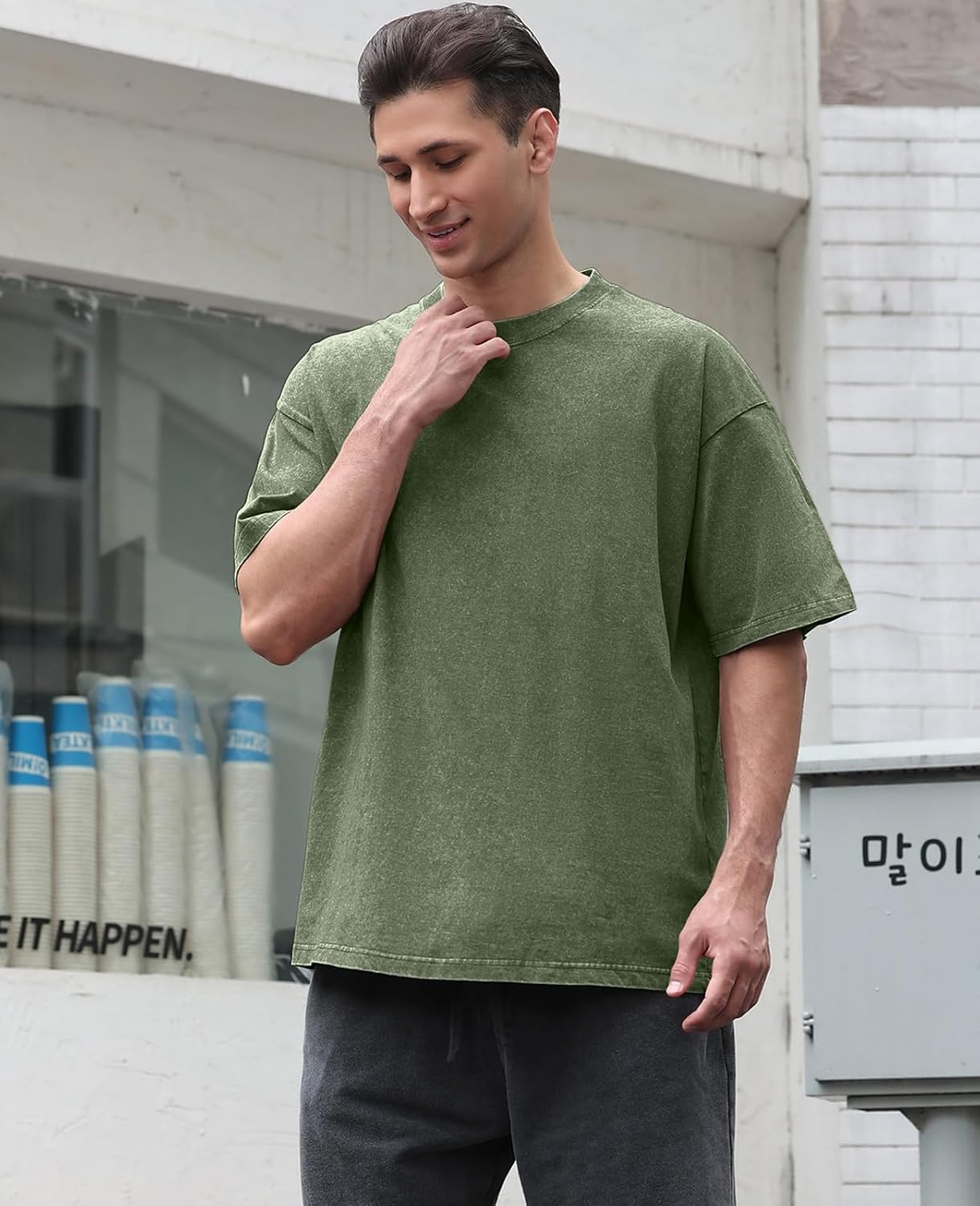
Acid-wash is one of those finishing techniques that looks effortless but is easy to get wrong. The short version: fabric (usually cotton) is treated with bleach, chlorine, or reactive chemicals after it’s been dyed — sometimes with stones or crumpled plastic to create irregular light and dark patterns — so the finished garment has that faded, lived-in, almost vintage look without the years of wear. Oversized, in the context of a t-shirt, means the piece is intentionally cut wider and longer than a standard “fitted” silhouette — more boxy, more dropped shoulder, often with extra length at the hem. Put those two things together with a heavier fabric weight (think: substantial, doesn’t cling, holds its shape), and you get the core category driving a huge share of streetwear basics purchases right now.
If you’ve been shopping this space for a few months, you already know the pitch. What you may not know yet is exactly why one $30 acid-wash tee ages into a wardrobe anchor while a $45 version from a different brand looks chalky and sad after two wash cycles. That gap is almost never about the aesthetic — it’s about construction decisions made long before the garment hits your hands. This guide unpacks those decisions and gives you a working decision framework you can apply to any piece you’re currently evaluating.
The Numbers That Actually Matter
Before we get into judgment calls, here’s the compressed spec landscape as of mid-2026:
| Price Point | Typical GSM | Dye Method | Expected Wash Retention |
|---|---|---|---|
| $20–$32 | 180–210g | Bleach discharge / piece-dyed | 3–6 washes before significant fade shift |
| $33–$50 | 220–280g | Reactive or garment-dyed | 8–15 washes with stable tonal range |
| $55–$90 | 280–320g+ | Enzyme-washed + reactive | 20+ washes; fade becomes controlled patina |
GSM (grams per square meter) is the weight measurement for fabric — higher means denser, heavier, more substantial. A standard Gildan blank runs about 185–200g. The heavyweight tier that streetwear brands have built their reputations on typically starts at 240g and goes up to around 320g for the thickest “boxy” silhouettes.
Why Fabric Weight Is the Loudest Signal in This Category
When you’re evaluating an acid-wash oversized tee, GSM is your first filter — not because heavier is always better, but because the chemical and mechanical stress of the wash process eats lighter fabrics faster.
Acid-washing isn’t gentle. Whether the brand is using a chlorine bleach discharge, a sulfuric-acid reduction, or a more modern enzyme-based process, the treatment breaks down the cotton fiber structure to create that soft, faded surface. On a 180g fabric, that breakdown is noticeable after a few home washes — you get pilling, thinning at the seams, and color that continues shifting unpredictably rather than settling. On a 260g or 280g fabric, the same chemical stress removes surface dye while leaving the underlying fiber integrity intact. That’s why owners consistently report that the mid-range heavyweight washed tees from brands like Dickies 874-adjacent labels, Los Angeles Apparel, and independent drop labels hold their look cycle after cycle — the foundation fabric can absorb the process without sacrificing structural integrity.
The Business of Fashion’s 2024 analysis of the washed-basics market noted that brands scaling quickly in this segment are making a deliberate trade: they’re investing in heavier base fabrics and absorbing the higher blank cost rather than spending on marketing, because word-of-mouth from longevity performs better than paid acquisition in the streetwear segment. That cost calculus shows up directly in your buying decision: a brand charging $38–$44 for a 260g acid-wash tee is almost certainly allocating more of that margin to the blank than one charging $45 for a 200g version with heavy branding.
The practical test: Look for GSM listed in product specs. If it isn’t listed, that’s a signal. Brands confident in their fabric weight advertise it. Those who omit it are usually working with commodity blanks.
The Dye Process Divide: Discharge vs. Garment-Dye vs. Enzyme Wash
This is where the $30-vs-$45 question actually lives. Three processes dominate this category, and they produce meaningfully different results.
Bleach discharge is the oldest and cheapest method. The fabric is dyed first, then selectively bleached — either with stones in a tumbler or with a crumple-and-dip technique — to pull color from certain areas. The result looks dramatic immediately. The problem: bleach is oxidizing, meaning it continues affecting the fabric chemically even after washing out. Owners of discharge-processed tees frequently report that the contrast between light and dark areas increases unpredictably after home washing, and that the lighter areas can develop a slightly yellow or gray cast over time. At the $20–$30 price point, you’re almost always getting this process.
Garment dyeing with reactive chemistry is the mid-tier standard. The blank is constructed first, then dyed as a finished garment. The acid-wash variation involves treating the dyed garment with reactive chemicals (sodium hypochlorite alternatives, or potassium permanganate for specific effects) to create tonal variation. Highsnobiety’s 2023 guide to garment dyeing noted that this process creates the most “vintage-authentic” result because the dye variation follows the actual stress points of the finished garment — seams, hems, shoulder points — rather than a mechanical pattern applied to flat fabric. It’s also more wash-stable because the reactive chemistry bonds differently to cotton than straight bleach. This is where most of the credible $35–$55 market sits.
Enzyme washing is the premium finishing step, often layered on top of garment dyeing. Enzymes (cellulase, typically) are biological compounds that break down cotton surface fibers selectively, creating a smoother, slightly “peached” hand feel while softening the overall look without aggressive chemical exposure. Brands in the $55–$90 range — and some Japanese mill-adjacent labels selling higher — use enzyme finishing as their differentiator. Per Textile Exchange’s 2024 Preferred Fiber & Materials report, enzyme-based finishing is also substantially more water-efficient than stone or bleach processes, which is increasingly a factor in supply chain sourcing decisions for brands that publish sustainability credentials.
Decision frame: If you’re buying for personal wear and expect 12+ months of rotation, target garment-dyed reactive process at minimum. If you’re sourcing blanks for a custom project where you plan to add your own print or design, enzyme-washed bases give you the cleanest surface for subsequent work.
Construction Details That Separate the Keeper From the Disappointment
Fabric and dye are the headline specs, but seam and cut construction determines whether a $38 tee feels like a $70 tee once it’s on.
Side seams vs. tubular construction. Cheaper tees are knitted in a tube and cut — no side seams, faster production, lower cost. This is fine for basic blanks but creates a problem in oversized silhouettes: tubular construction tends to torque (twist) after washing, because the fabric’s tension is released unevenly. A side-seamed tee holds its shape and hangs correctly through repeated wash cycles. In the acid-wash oversized category, side seams are almost a prerequisite for anything you expect to wear more than a season.
Double-needle hems. This is the single most reliable quality indicator you can check without reading spec sheets. Flip the tee inside out at the hem and sleeve cuffs. A double-needle finish shows two parallel rows of stitching — it holds its shape, resists curl, and indicates the manufacturer didn’t cut corners on finishing. Single-needle or coverstitch-only hems are more common in the under-$30 tier and tend to roll after washing.
Shoulder drop and sleeve placement. In a genuine oversized construction, the shoulder seam sits 1–2 inches past the natural shoulder point, and the sleeve is cut to match that dropped position. What some brands do instead — and this is a known shortcut flagged by reviewers at GQ’s 2025 oversized tee roundup — is take a standard-fitted pattern and simply size up 2–3 sizes without adjusting the shoulder architecture. The result is a tee that’s wide and long but doesn’t drape correctly: the sleeves hang wrong, the chest pulls awkwardly, and it doesn’t read as intentionally oversized so much as just ill-fitting. Check for “drop-shoulder” or “boxy cut” in the product description; those terms indicate the pattern was constructed for the silhouette, not adapted from a fitted base.
The Real Price-to-Value Split: Where to Land Based on Your Use Case
The intermediate-practitioner mistake in this category is treating $45 as automatically better than $30. Price is only a reliable signal when the spec differential is visible — and plenty of $45 tees are $30 tees with a better logo and heavier cardboard packaging.
Here’s the honest decision tree:
If you’re building a personal rotation (5+ wears per month): Spend $38–$50 and confirm: 240g+, garment-dyed process, side-seamed construction, double-needle hem. The Hypebeast Spring 2025 heavyweight tee roundup identified this tier as the “sweet spot” for the ratio of durability to cost in the washed-basics market — consistent with what owners report when reviewing mid-tier releases from brands like Carhartt WIP, Our Legacy’s basics line, and similar weight-forward labels.
If you’re sourcing for custom print or creative work: Go 260g+ enzyme-washed blank, even if it costs $42–$55 wholesale per unit. The surface behavior matters more than anything else when you’re adding ink or embroidery — a discharge-bleached base creates unpredictable color interaction with water-based inks, while an enzyme-washed surface accepts prints cleanly.
If you’re buying a statement piece or tracking a limited drop: The spec conversation changes. At $80–$120+ for a limited acid-wash drop from an independent label or Japanese-adjacent brand, you’re partly paying for provenance and scarcity. The wash quality at this tier is generally excellent (brands operating here can’t afford returns or reputation damage), but the price isn’t purely material — it includes the cultural value of the object. That’s a legitimate purchase; just go in clear about what you’re buying.
If the brand won’t publish fabric weight: Walk. In 2026, with the amount of spec-transparency pressure on the market documented by Business of Fashion’s washed-basics coverage, a brand hiding GSM is hiding something.
The One-Sentence Rule
Every acid-wash oversized tee buying decision compresses to this: if the brand can tell you the GSM, the dye process, and the construction method — and those numbers are 240g+, garment-dyed, and side-seamed — you have a keeper regardless of the price point; if any of those three are missing or below threshold, the extra $10–$15 you’re being asked to pay is margin for the brand, not value for you.
The $30 keeper exists. The $45 disappointment is real. The difference is in the specs, not the sticker.