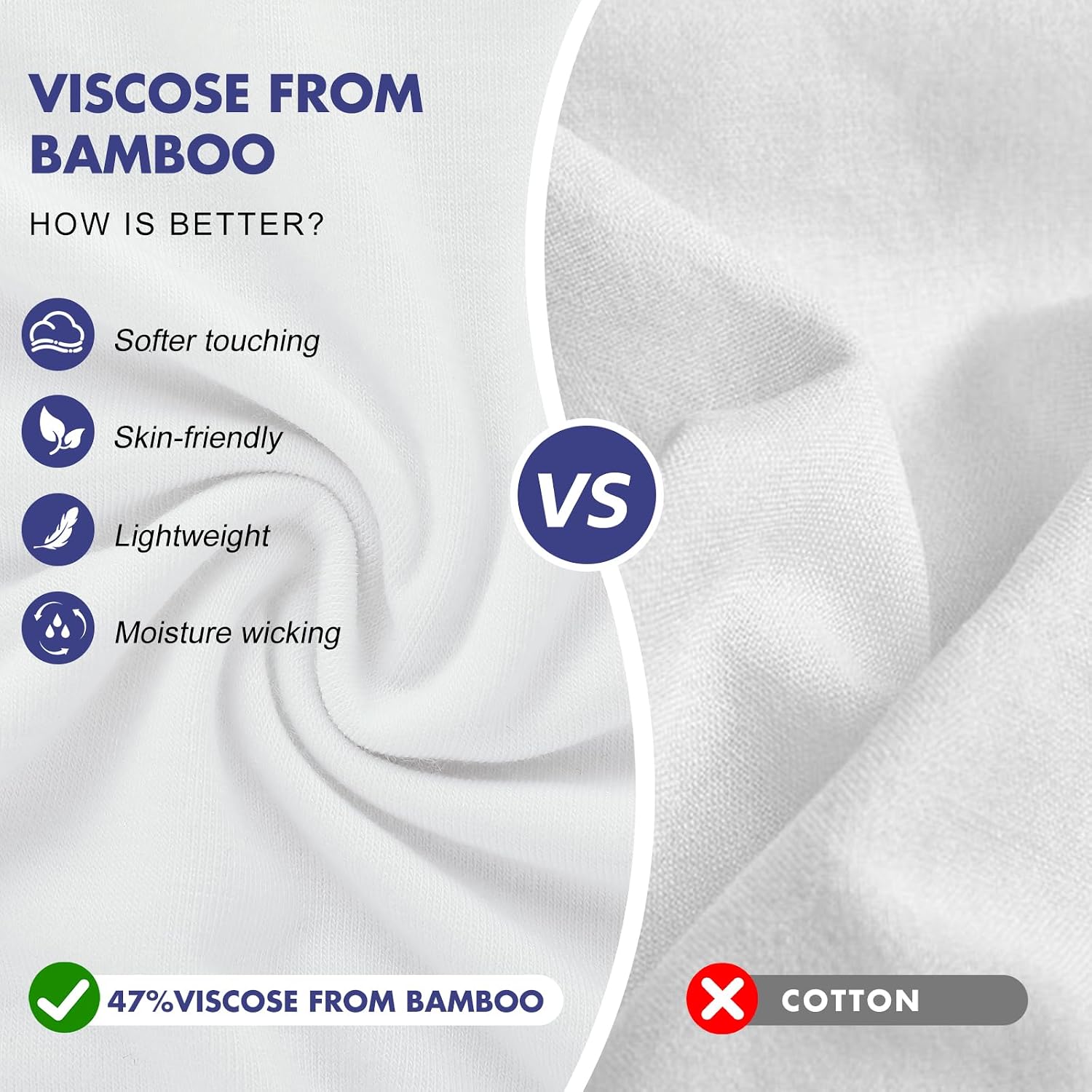
If you’ve shopped for a soft, lightweight tee in the last few years, you’ve almost certainly seen “bamboo” on a hang tag. The pitch is compelling: a plant that grows without pesticides, harvested at scale, spun into a fabric that feels like the love child of jersey cotton and silk. First-time buyers often reach for bamboo tees because the softness is genuinely noticeable on the rack. But once you start caring about fabric construction — once you’re comparing GSM weights, reading fiber content labels, and wondering why your $60 bamboo tee pills after six months — the story gets more complicated. This guide breaks down exactly what “bamboo fabric” means in practice, why the marketing often outpaces the material reality, and how to make a clear-eyed decision about whether bamboo belongs in your rotation or your recycling bin.
What “Bamboo” Actually Means on a T-Shirt Label
Here’s the thing the hang tag doesn’t tell you: almost no commercially available bamboo t-shirt is made from bamboo fiber in the way that a cotton tee is made from cotton fiber. When you buy a bamboo tee, you are almost certainly buying bamboo viscose (also called bamboo rayon) — a semi-synthetic fiber produced by dissolving bamboo pulp in a chemical bath, extruding it into filaments, and reconstituting it as a wearable yarn. The bamboo plant is the raw material input, but the output fiber shares virtually no structural properties with the original plant.
The Federal Trade Commission addressed this directly. Per the FTC’s guidance document Threading Your Way Through the Labeling Requirements Under the Textile and Wool Acts, brands are legally required to label bamboo viscose as “rayon” or “viscose made from bamboo” — not simply “bamboo.” The FTC has issued enforcement actions against several brands for calling their products “bamboo fabric” when the actual fiber was viscose. If your tee’s label just says “bamboo,” that’s a compliance red flag worth noting.
There are two narrower bamboo fiber categories you’ll encounter less often:
- Bamboo linen (mechanically processed bamboo): Closer to true plant fiber, but coarser in feel. Rare in the t-shirt market because the hand feel is rough compared to viscose.
- Bamboo lyocell (sometimes branded as bamboo Tencel): A closed-loop process that recovers most of the solvent used in production. Meaningfully cleaner environmentally, but still a semi-synthetic. Still uncommon at scale.
For practical purposes: when a brand says “bamboo tee,” assume bamboo viscose until the label proves otherwise.
The Softness Is Real. Here’s Why — and Why It Fades.
Bamboo viscose earns its softness reputation honestly. The fiber has a round, smooth cross-section under a microscope, which means individual filaments lie flat against each other and against your skin. There’s no prickle point the way there can be with lower-grade cotton or wool. Hohenstein Institute’s white paper on functional properties of bamboo viscose fibers notes that the fiber’s micro-structure contributes to a perceived smoothness that many wearers describe as comparable to modal or high-grade jersey.
The problem is durability under repeated mechanical stress — meaning washing and wearing.
Viscose, regardless of source material, is a relatively weak fiber when wet. This is the core tradeoff the marketing glosses over. Across aggregated owner reviews and long-wear commentary on sites including Highsnobiety’s fabric deep-dives and editorial sourcing notes at Business of Fashion, the pattern is consistent: bamboo viscose tees feel exceptional at first wear and begin showing pilling, fabric thinning, and shape distortion after roughly 20–40 wash cycles, depending on water temperature and spin intensity. That’s a meaningfully shorter lifespan than a well-constructed ring-spun cotton tee at similar price points.
By the numbers:
| Property | Bamboo Viscose | Ring-Spun Cotton (180–200 GSM) | Pima/Supima Cotton |
|---|---|---|---|
| Initial softness | Very high | Moderate–high | High |
| Wet tensile strength | Low | High | High |
| Pill resistance | Low–moderate | Moderate–high | High |
| Estimated wash cycles before visible wear | 20–40 | 80–150+ | 100–200+ |
These figures reflect manufacturer-published fiber specs and aggregate owner reporting — not a single controlled test, but a pattern consistent enough across sources to be decision-relevant.
The Environmental Claim: Greener Than Cotton, or Greenwashing?
The sustainability pitch for bamboo is, at first pass, genuinely appealing. Bamboo is a fast-growing grass that requires no replanting, uses significantly less water than conventional cotton farming, and can grow without pesticides. On the raw-material side, the Textile Exchange’s Preferred Fiber & Materials Market Report 2024 acknowledges bamboo’s agronomic advantages: low land input, rapid carbon sequestration, and no irrigation dependency in native growing regions.
The problem enters in the conversion stage. Turning bamboo pulp into viscose fiber requires sodium hydroxide and carbon disulfide — industrial chemicals that can harm workers and waterways if processing facilities lack adequate effluent management. In a 2023 briefing, Canopy Planet’s Hot Button Hierarchy: Bamboo Viscose and Forest Fibre Sourcing report flagged that many bamboo viscose supply chains lack third-party verification of chemical handling practices, and that the “natural” framing of bamboo fabric marketing frequently obscures the industrial reality of viscose conversion.
The takeaway for a buyer who cares about sourcing: bamboo viscose is not the closed-loop environmental win its marketing suggests. If sustainability is your primary driver, bamboo lyocell (look for OEKO-TEX certification and a named closed-loop solvent process) is the more defensible choice. If it’s not your primary driver, weight the environmental claim at roughly zero and evaluate the garment on feel, construction, and cost-per-wear.
Business of Fashion’s 2024 piece on the greenwashing gap in natural-feel synthetics makes the broader point clearly: viscose-family fibers (modal, bamboo viscose, regular rayon) occupy an awkward middle ground where consumers perceive them as natural because of their plant origin, while regulators and textile scientists classify them as semi-synthetic because of the degree of chemical transformation.
Where Bamboo Viscose Actually Wins
This isn’t a categorical dismissal. There are specific use cases where bamboo viscose earns its place in a considered wardrobe:
Hot-weather and athletic-adjacent wear. Bamboo viscose has measurable moisture-wicking properties and a naturally draping silhouette that performs well in heat. For a casual summer tee you’ll wear 10–15 times rather than 60, the durability math is less punishing. Brands positioning bamboo tees in the activewear-adjacent or vacation-capsule category are making a contextually honest argument.
Next-to-skin sensitivity. For wearers who react to lower-grade cotton or whose skin registers coarser fabrics as irritating, bamboo viscose’s smooth fiber profile is genuinely useful. The sensory benefit is real, even if it degrades over time.
Layering pieces and undershirts. At the price points bamboo tees typically occupy ($30–$80), the per-wear value works out reasonably well if the garment functions as a layering piece worn once before washing rather than an outerwear tee rotated heavily.
Where it underdelivers: As a standalone, frequently washed, long-term-wardrobe tee — the core use case that a Merz b. Schwanen loopwheel or a Sunspel Sea Island cotton fills. The durability gap is too significant.
How to Read a Bamboo Tee’s Label Before You Buy
If you’re standing in front of a rack and want a quick decision framework:
-
Find the fiber content label. It should say “viscose” or “rayon” — not just “bamboo.” If it says bamboo with no clarifying fiber classification, the brand may be misrepresenting the material or operating outside FTC labeling guidelines.
-
Check the blend. Many of the better-performing bamboo tees blend viscose with organic cotton or spandex. A 70/30 bamboo viscose-cotton blend will hold its shape meaningfully better than 95% viscose with 5% spandex, because the cotton component adds wet-strength stability. The spandex-heavy versions (10%+) are optimizing for stretch recovery, which helps athletic fits but accelerates pilling in the torso.
-
Look for OEKO-TEX Standard 100 certification. This doesn’t confirm environmental production practices end-to-end, but it does indicate the finished fabric has been tested for harmful chemical residue — relevant given the chemical-intensive conversion process.
-
Check the GSM if it’s disclosed. Bamboo viscose tees below 150 GSM (grams per square meter — the standard measure of fabric weight and density) are typically too thin for outerwear use. 160–180 GSM is a reasonable floor for a tee you’re treating as a standalone garment.
-
Ignore the “anti-bacterial” claim. This was derived from properties of the raw bamboo plant and does not transfer reliably to processed viscose fiber. The Hohenstein Institute’s analysis found no consistent antibacterial performance in bamboo viscose textiles after washing, despite widespread marketing claims to the contrary.
The Decision Rule
If you’re weighing bamboo against your other options at the $40–$80 tier, here’s how to frame it cleanly:
If you want a soft, breathable warm-weather tee for a defined season (30–40 wears) and you’re not expecting long-term rotation: bamboo viscose is a legitimate choice. The feel-per-dollar is competitive, and the durability limitations are acceptable within that use window.
If you want a true wardrobe staple — something you’ll wash 80+ times and reach for across multiple years: the durability math doesn’t work. Spend the same money on a heavier Supima cotton blank, a Pima jersey from a brand with honest sourcing transparency, or stretch into the loopwheel or garment-dye tier if longevity and texture are the goal.
If environmental impact is the deciding factor: don’t take the bamboo claim at face value. Ask for lyocell specifically, look for third-party chemical certification, and verify that “bamboo” is backed by a disclosed production process rather than raw-material origin alone.
The softness is real. The rest of the story requires a more careful read than most hang tags are willing to give you — and now you have it.