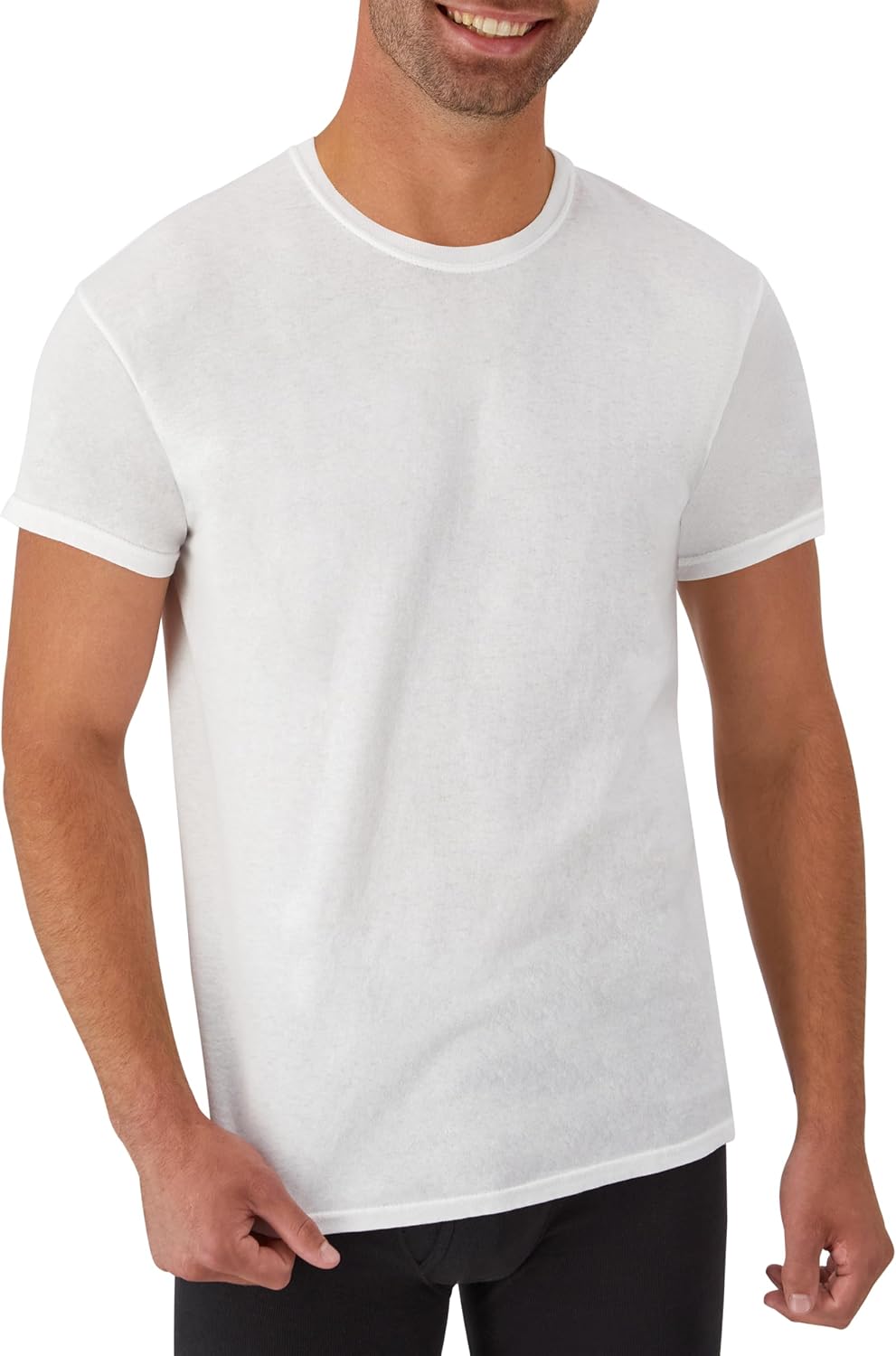
An undershirt is exactly what it sounds like: a lightweight layer worn directly against your skin, underneath your dress shirt, oxford, or even a heavier T-shirt. Most men reach for whatever multi-pack is on sale and move on. That works — until the shirt you spent $90 on shows sweat rings at a work lunch, or the neckline of your crew-neck tee bulges with a visible collar. The undershirt is the unglamorous foundation of the whole outfit, and getting it wrong costs you more than you realize — in ruined outer shirts, in confidence, and in replacement cycles that add up fast. This guide is about making one deliberate choice instead of a dozen mediocre ones. We’ll cover fabric, cut, weight, and the situations where each option earns its place.
| EDITOR'S PICK[Polo Ralph Lauren Underwear Men…](https://www.amazon.com/dp/B07FMX9FSF?tag=greenflower20-20) | Mid-tier[Fruit of The Loom Men's Premium…](https://www.amazon.com/dp/B00XC15AMW?tag=greenflower20-20) | Budget pick[Hanes Men's Undershirt Packs](https://www.amazon.com/dp/B00L6PI71W?tag=greenflower20-20) | |
|---|---|---|---|
| Fit | Slim Fit | Regular | — |
| Tagless | — | ✓ | — |
| Stay-Tucked | — | — | ✓ |
| Price | $38.50 | $27.60 | $15.95 |
| See on Amazon → | See on Amazon → | See on Amazon → |
The Three Decisions That Actually Matter
Most undershirt confusion comes from treating it as one category. It isn’t. There are really three separate decisions stacked on top of each other, and if you get the sequencing right, the specific brand matters less than you think.
Decision 1: Neckline (crew vs. V-neck vs. deep V)
The neckline isn’t about aesthetics on the undershirt itself — it’s about what your outer layer exposes. A crew-neck undershirt under a dress shirt leaves no visible collar, which is exactly right when the dress shirt is buttoned to the top. Open one button, and the undershirt collar peeks out, and you’ve already lost the plot. A V-neck solves this for open-collar dress shirts, but Go too deep with the V on a casual tee and the undershirt reads as visible lingerie.
Put This On’s guide to undershirts frames it cleanly: the rule is that the undershirt should never be the first thing a viewer’s eye lands on. It exists to protect and to regulate temperature, not to be seen. That means matching neckline depth to the realistic range your outer shirt will expose.
Decision 2: Fabric (cotton, modal, microfiber, merino)
This is where most of the quality gap lives. Let’s define the main contenders:
- Conventional cotton (most multi-packs) is breathable and cheap, but it holds moisture against the skin once you start perspiring. It also tends to stretch out at the collar and hem within six months.
- Ring-spun cotton is conventional cotton that’s been continuously twisted during spinning, which makes the individual fibers align more tightly, producing a softer, more durable fabric. Ring-spun is what distinguishes a $22 blank from a $6 multi-pack shirt in terms of longevity.
- Modal is a semi-synthetic fabric derived from beech tree pulp. It’s silky-soft, holds its shape under repeated washing better than most cottons, and drapes tightly enough against the torso to avoid bunching under dress shirts. Reviewers across multiple buying guide outlets — including Wirecutter’s undershirt roundup — consistently flag modal as the material that converts skeptics.
- Merino wool sounds counterintuitive as an undershirt fabric, but it’s genuinely excellent for temperature regulation. It wicks moisture away from skin and manages odor at a structural level, meaning you can wear it on travel days without the shirt becoming unwearable by afternoon. The tradeoff is cost and care — merino undershirts run $40–$80 each and typically require gentle-cycle washing.
- Microfiber / performance synthetics (polyester blends, often marketed as “moisture-wicking”) move sweat away aggressively and dry fast. They’re best suited to physical activity. Under a structured dress shirt at a formal meeting, a synthetic undershirt can trap heat and create a clammy feeling that defeats the purpose.
Per Textile Exchange’s Preferred Fiber & Materials Market Report 2024, blended fabrics that combine modal or Pima cotton with a small percentage of elastane (spandex) — typically 5–8% — now dominate the performance undershirt segment, because the elastane allows the garment to recover its shape through the stretch cycles of a normal workday.
Decision 3: Fit (fitted vs. relaxed, stay-tucked length)
The single most-overlooked spec in undershirt buying is hem length. A standard undershirt hem sits at the hip. After three hours of moving, sitting, and reaching, it has untucked and bunched somewhere around your waistband, creating a ridge visible through any shirt with a close cut. The fix is a “stay-tucked” cut — an extended hem, typically 3–5 inches longer than a standard tee, designed to stay below the waistband even at full arm extension.
GQ’s undershirt guide consistently flags stay-tucked length as the differentiating spec that separates dedicated undershirts from repurposed T-shirts. An undershirt that untucks is an undershirt that failed its only real structural job.
By the Numbers
| Fabric Type | Avg. Price/Unit | Wash Cycles Before Noticeable Wear* | Best Use Case |
|---|---|---|---|
| Conventional cotton (multi-pack) | $4–$8 | ~40–60 | Casual, athletic |
| Ring-spun cotton | $18–$35 | ~80–100 | Everyday, business casual |
| Modal or modal-blend | $22–$45 | ~100–120 | Dress shirts, office |
| Merino wool | $40–$80 | ~150+ (if hand/gentle washed) | Travel, temperature-variable days |
*Wash cycle durability figures drawn from aggregated owner reviews and manufacturer guidance across major retail platforms, not lab evaluation.
Matching Undershirt to Context: The Decision Framework
Here’s where the practitioner mindset pays off. The question isn’t “what’s the best undershirt” in the abstract — it’s “best for which configuration of my actual life.”
If you wear structured dress shirts to client meetings or formal settings: Go modal or Pima cotton, fitted, V-neck, stay-tucked length. The priority is zero visibility and no bunching. You want the undershirt to disappear completely and manage sweat without soaking through to the outer layer. Modal’s drape is your friend here — it lies flat against the body without creating bulk under a tailored shirt. Mr Porter Journal’s “The Basics, Revisited” piece specifically calls out modal-blend undershirts as the choice for men wearing European-cut dress shirts where any fabric bulk reads immediately.
If your wardrobe is primarily business casual (oxford shirts, henleys, unfussy chinos): Ring-spun cotton in a fitted crew or moderate V covers most days. This is the tier where price-to-value reasoning is sharpest. A ring-spun cotton undershirt at $22–$30 lasts two to three times as long as a multi-pack option and doesn’t require the delicate handling of merino. You’re not optimizing for invisibility under a thin dress shirt, so the slightly more textured hand of ring-spun cotton isn’t a liability.
If you travel frequently or deal with unpredictable temperature environments: Merino is worth doing the math on. The durability story is real — owners consistently report merino undershirts outlasting cotton equivalents by years when properly cared for — and the odor-management function means you carry fewer units on a trip. The cost is front-loaded ($50–$80 per unit), but a four-piece merino rotation that lasts five years clears a lower cost-per-wear than a six-pack of cotton undershirts replaced annually.
If you run hot or work in environments where sweating is a realistic daily variable: This is the one case where a performance-synthetic or modal-cotton blend with active moisture-wicking properties earns a place in the rotation. The key distinction: wicking fabrics pull moisture away from skin efficiently, which helps with comfort, but they don’t prevent sweat from reaching the outer shirt the way a thicker cotton layer does. Think of them as managing comfort, not managing optics.
Common Mistakes and How to Correct Them
Sizing down for a “compression” effect. Some men buy undershirts a size small believing a tighter fit prevents bunching. In practice, owners report this creates collar stretch within weeks, because the fabric is under tension every time the shirt goes over the head. Fit should be snug but not constricting — the shirt should lie flat without pulling across the chest at rest.
Buying white and stopping there. White undershirts make sense under white dress shirts. Under anything pale blue, pink, or grey, a white undershirt can create a bright visible patch at the chest. A grey undershirt — counterintuitively — disappears under almost every color because it doesn’t create contrast the way white does. Wirecutter’s undershirt coverage specifically flags heather grey as the most universally invisible color under light-to-medium dress shirts, a detail that gets overlooked in most buying conversations.
Washing on hot. Cotton undershirts washed consistently on hot cycles shrink at the collar and hem, which accelerates the untucking problem and degrades elasticity faster. Cold or warm wash, tumble dry low: the difference in longevity is measurable.
Buying the wrong neckline for your outer wardrobe. If you rotate between crew-neck T-shirts and open-collar dress shirts on different days, a single neckline won’t serve both. The actual solution isn’t to compromise — it’s to own two small stacks: V-necks for dress-shirt days, crew necks for T-shirt layering. The per-unit cost of undershirts at the modal or ring-spun tier means a split rotation of eight total shirts is a $200–$250 investment that handles most real wardrobe configurations without daily visible failures.
The If/Then Decision Grid
- If you wear structured shirts to formal or client-facing settings → then modal or Pima blend, V-neck, stay-tucked, fitted. Prioritize invisibility and hem length above all.
- If your daily context is business casual or creative-office → then ring-spun cotton, crew or moderate V, fitted. Best price-to-longevity ratio at this use level.
- If you travel 8+ days a month or work in variable temperatures → then merino rotation. Front-load the cost, lower the carry weight, and stop thinking about it.
- If you run physically hot or perspire heavily in normal daily conditions → then modal-elastane blend with explicit moisture-wicking construction, but pair with a dress shirt that has enough weight to buffer transfer.
- If you’re currently buying multi-packs annually → then calculate what you’ve actually spent over three years, compare to four modal units at $30 each, and recognize the math has been running against you.
The undershirt is one of those purchases where the research-to-reward ratio is unusually high. A single deliberate choice, made once, holds for years. The decision isn’t complicated — it just requires asking the right questions about your actual wardrobe before defaulting to the nearest multi-pack.