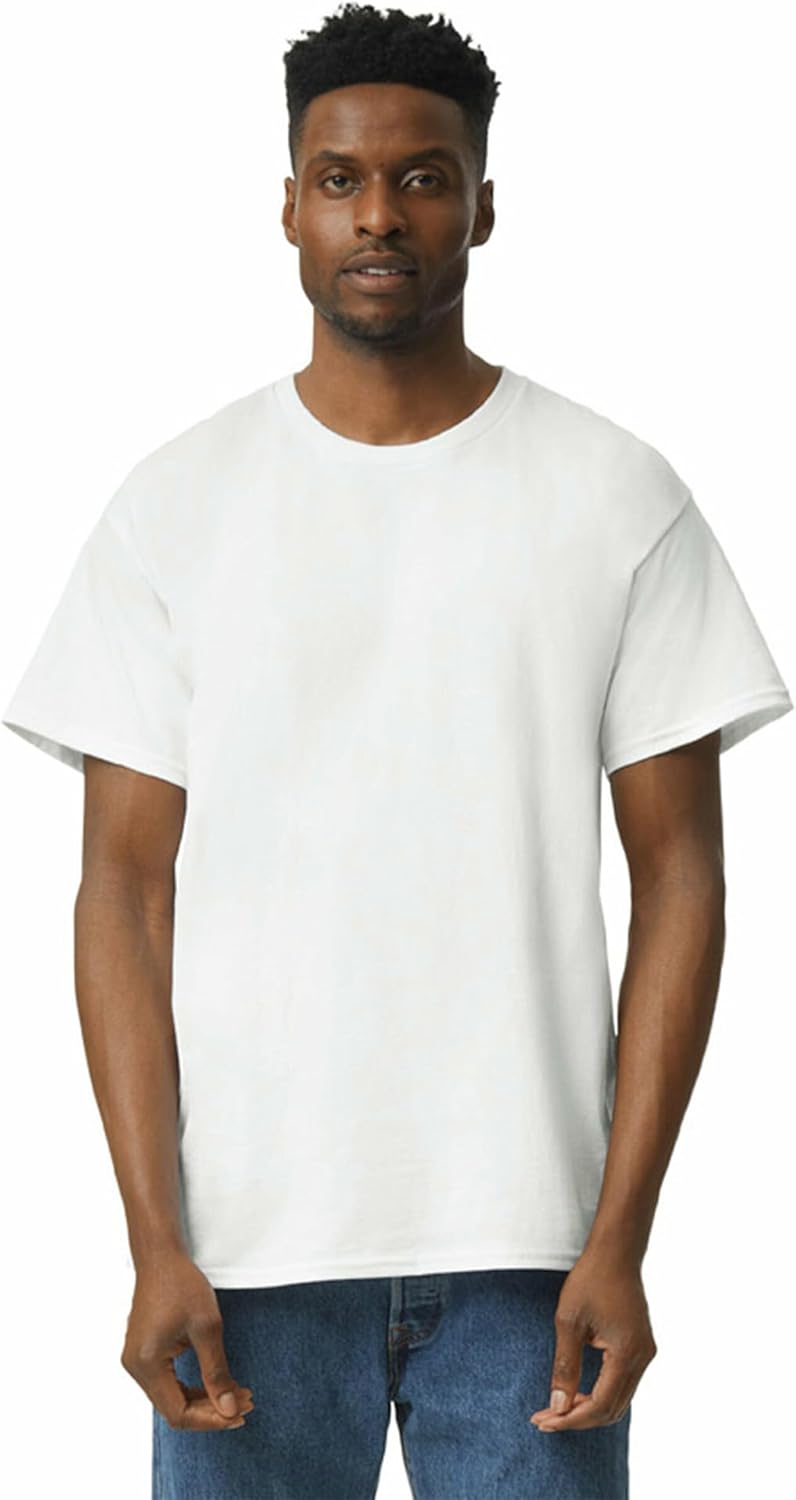
The white t-shirt is the most-bought, most-second-guessed item in any wardrobe. Walk into a store or open a browser and you’ll face a dizzying range of options — from a three-pack for $12 to a single tee priced at $120. The difference isn’t always obvious from a photo. It lives in the fabric: its weight (measured in grams per square meter, or GSM — heavier generally means more structure and durability), its cotton type (combed, ring-spun, Pima, and Sea Island are progressively refined and softer grades of cotton fiber), and how the garment is cut and finished. This guide cuts through the noise at five distinct price points, from a first-buy blank up to a true investment piece, and gives you a clear decision rule at every tier. If you already know your ring-spun from your Supima, skip straight to the section that matches your budget — the tradeoff logic is where this gets useful.
The $10–$15 Tier: The Honest Blank
Best representative: Gildan 64000 Softstyle, Bella+Canvas 3001
At this price, you are buying a functional, commodity white tee — and that’s completely fine if you know what you’re getting. Gildan’s Softstyle line runs at approximately 153 GSM, which places it at the lighter end of the spectrum. Bella+Canvas’s 3001 lands closer to 145 GSM with a ring-spun construction (meaning the cotton fibers are twisted under tension before spinning, which removes short, scratchy fibers and produces a smoother hand feel than standard open-end spinning). Both are made with a combed and ring-spun cotton blend, which is a meaningful upgrade over the heavier, rougher Gildan 2000 that dominated the blank market a decade ago.
What you’re buying: A serviceable, slightly sheer tee that will wash acceptably for 20–40 cycles before pilling or developing yellowing around the collar. Wirecutter’s white t-shirt coverage consistently notes that cheaper tees shed weight and shape after repeated high-heat drying — the fabric simply can’t hold its structure. Owners of the Bella+Canvas 3001 report that fit is slim and consistent across sizes, which makes it a popular blank for custom printing. For casual wear or layering under flannels, it earns its place.
Where it breaks down: Opacity. At 145–153 GSM, a single layer of white fabric is translucent under bright light. You’ll need to size up or double-layer if opacity matters. The collar also tends to lose its shape faster — the knit is not reinforced with tape or a denser rib, so expect stretching by wash cycle 15 or so.
Decision rule: Buy here if you’re printing on blanks for a small run, testing a new fit silhouette, or need rotation tees you’ll wear under something else. Don’t buy here expecting a standalone, wear-alone white tee that photographs clean and holds up a year from now.
The $20–$35 Tier: The Sweet Spot for Most People
Best representatives: Uniqlo Supima Cotton Crew, Everlane The Organic Cotton Crew, American Giant Classic Crew
This is where white t-shirt math gets genuinely interesting. A Uniqlo Supima Cotton tee retails around $20–$25 (prices in May 2026 sit in that window depending on region), and it punches well above its price. Supima is a trademarked grade of American-grown Pima cotton — a long-staple fiber, meaning the individual cotton fibers are longer, which produces a silkier texture and stronger yarn. GQ’s roundup of best white t-shirts has repeatedly placed the Uniqlo Supima in its top three for the value tier, noting the consistency of fit across seasons and the fabric’s resistance to pilling.
Everlane’s Organic Cotton Crew runs $28–$35 and uses a slightly heavier construction, closer to 180 GSM, in a relaxed fit that reviewers at Wirecutter describe as flattering across body types. The tradeoff is that “organic” labeling, while meaningful for environmental reasons (Textile Exchange’s 2024 Preferred Fiber & Materials Market Report documents that certified organic cotton reduces synthetic pesticide use by over 90%), does not automatically mean softer or more durable. Organic cotton at this price tier is often standard-staple length — not long-staple Pima — so you’re trading some tactile refinement for provenance.
American Giant’s Classic Crew is a domestic-made option around $38 — just at the ceiling of this tier. It runs at approximately 200 GSM, with a noticeably heavier, more structured feel. Owners consistently report that it holds its shape through dozens of washes better than either of the above.
By the numbers:
| Brand | Approx. GSM | Cotton type | Made in | ~Price (2026) |
|---|---|---|---|---|
| Uniqlo Supima | 160 | Supima (long-staple) | Bangladesh | $20–$25 |
| Everlane Organic | 180 | Organic standard | Vietnam/Portugal | $28–$35 |
| American Giant Classic | 200 | US Supima ring-spun | USA | $38 |
Decision rule: If fit consistency and ease of repurchase matter most, Uniqlo wins this tier on reliability and value. If you want domestic manufacturing and a heavier, more opaque tee you’ll keep for three-plus years, the American Giant at $38 is worth crossing the tier boundary.
The $40–$65 Tier: Where Construction Starts to Show
Best representatives: Buck Mason Slub Tee, Entireworld Type A Tee, Merz b. Schwanen 215
This is the practitioner’s decision tier — the range where you start paying for construction details that make a real difference, not just brand positioning. The key upgrades at $40–$65 involve fabric character, side-seam taping, and collar construction.
Buck Mason’s Slub Tee (approximately $52) is made from a “slub” cotton — a yarn with intentional, irregular thick-and-thin variations built into the spinning process. This creates a subtle texture that makes the white tee look less stark, more considered. Owners report it softens further with washing. The fit is slightly longer in the body with a narrower shoulder, which reads as modern without being fashion-forward. Put This On’s editorial coverage of American premium basics has cited Buck Mason as one of the few mid-tier brands that genuinely controls its fit spec rather than chasing trend silhouettes.
Merz b. Schwanen’s 215 is a German heritage brand running at roughly $65 for a loopwheeled tee. Loopwheeling is a slow, antique knitting method (on machines that run at a fraction of the speed of modern circular knit machines) that produces a fabric with a tighter, more even loop structure, a distinct “hollow” softness, and exceptional shape retention. Business of Fashion’s coverage of premium basics manufacturing has noted that loopwheeled production in Europe and Japan is one of the last categories where craft construction commands a genuine performance premium, not just a story premium. The Merz 215 runs slightly boxy, consistent with vintage American workwear proportions.
Where this tier falls short: Opacity remains a mild issue for the slub fabrics — the irregular yarn creates thin spots. And at $52–$65, you’re starting to pay for brand narrative alongside the construction. Know which you’re buying.
Decision rule: If you want texture and character in your white tee — the one that looks intentional with a blazer or tucked into trousers — this tier delivers it. If you want the cleanest, most opaque, most refined white, save money and move to the next tier. The $40–$65 range is strongest for people who wear their white tee as a visible, standalone layer.
The $75–$110 Tier: The Investment Piece
Best representatives: Sunspel Classic Crew (Sea Island cotton), Officine Générale Lightweight Slub Tee, Rag & Bone Classic Base Tee
You are now in the territory where cotton type becomes the central value driver. Sunspel’s Classic Crew, made in England from Sea Island cotton — the rarest commercial cotton grade, grown on a small number of Caribbean islands, with fiber lengths significantly longer than even Supima — retails at approximately $95–$110 in 2026. Sea Island cotton is not a marketing term; Textile Exchange’s fiber documentation distinguishes it as a distinct Gossypium barbadense variety with a mean fiber length measurably longer than standard Pima or Egyptian. The practical result, as consistently reported by owners and reviewers at MR PORTER’s journal coverage of Sunspel, is an almost silky hand feel, exceptional luster, and a tee that gets better with age rather than deteriorating.
Officine Générale’s Heavyweight Slub runs around $85 and takes a different approach — a thicker, more opaque fabric with a dry, matte hand feel. The French brand’s reputation for precise, consistent sizing means owners report fewer fit surprises than at most brands in this range.
Rag & Bone’s Classic Base Tee at approximately $80 is the most accessible entry to this tier and functions as a true workhorse for wardrobe builders — clean lines, tight collar rib, consistent sizing. Esquire’s style coverage has repeatedly cited it as the baseline against which other investment basics are measured.
What the math actually says: A $95 Sunspel tee, maintained with cold wash and low-heat dry, can reasonably last 5–7 years as a primary rotation piece. A $20 Uniqlo Supima tee might last 18–24 months in heavy rotation before noticeable wear. The per-year cost is closer than the sticker price implies — but only if you actually care for the garment. If you wash hot and tumble dry high, the ROI flips hard.
Decision rule: If you want a white tee you’ll still be reaching for in year five — one that holds its shape, feels genuinely luxurious against skin, and looks sharp worn alone with trousers — the $95–$110 tier earns its cost. If your lifestyle involves frequent washing or rough treatment, you will not extract that value, and the $35–$65 range is more rational.
The Framework: Which Tier Is Actually Yours?
Most readers will find their honest answer lives one tier lower than they think and one tier higher than they’re currently buying. Here’s the clean version:
- You wash everything in one hot load and don’t think about it: Buy the $20–$25 Uniqlo Supima. Replace it annually without guilt.
- You care about fit and want a tee that looks intentional on its own: The $38–$65 range (American Giant to Merz b. Schwanen) is where construction finally justifies cost.
- You’re building a long-term wardrobe with fewer, better pieces: The $85–$110 tier is the right math — but only if you’ll maintain it.
- You need blanks for custom projects or high-volume rotation: The Bella+Canvas 3001 or Gildan 64000 at $10–$15 is the correct, professional choice, and there’s no shame in it.
The white tee is the one garment where every dollar you spend above the commodity floor is either earning its keep in construction, or it isn’t. This guide gives you the filter. The spend is yours.