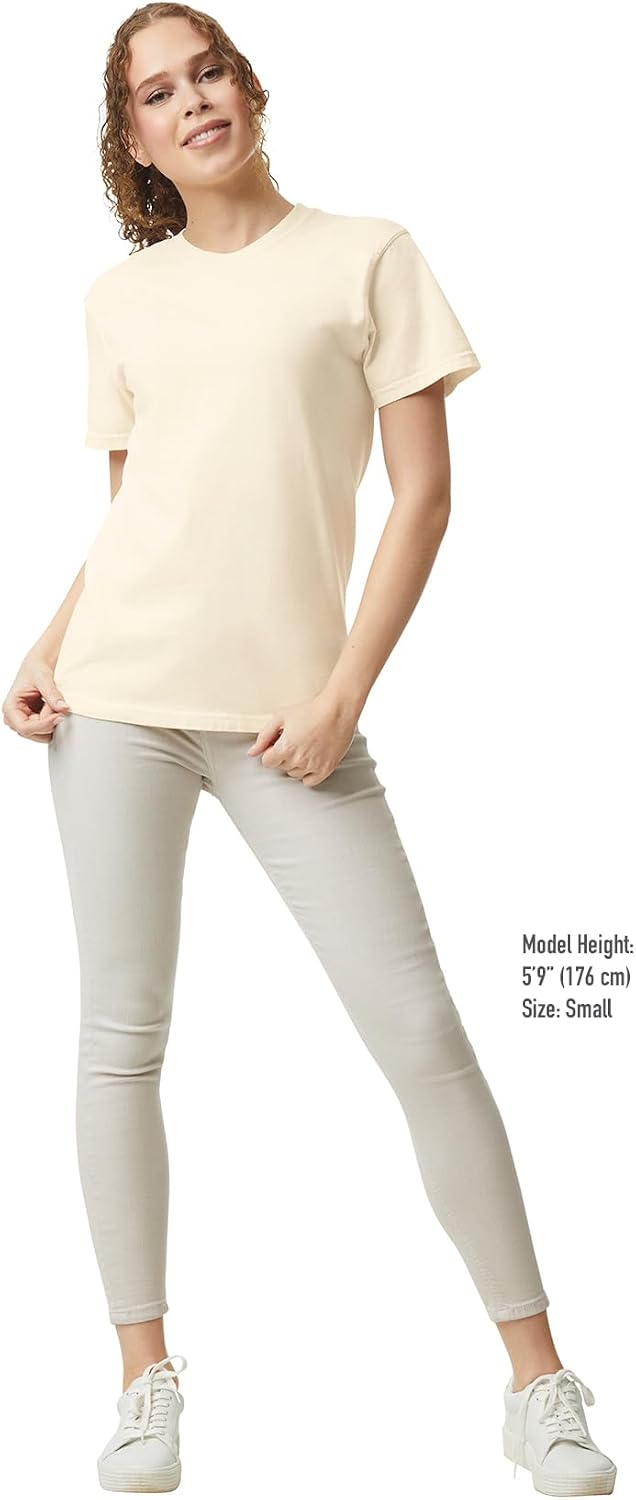
If you’ve ever grabbed a t-shirt off a rack and noticed it felt genuinely substantial — more like a second skin than a grocery bag — you were holding a heavyweight tee. The number that defines that feeling is GSM, which stands for grams per square meter: it’s the standard way the textile industry measures how much fabric is packed into a given area. Think of it as the cotton equivalent of thread count, except GSM is actually a reliable proxy for quality. The higher the number, the denser and heavier the knit. A thin, breezy summer tee might be 140–160 GSM. The “feels like it’ll outlive you” shirts that brands like Merz b. Schwanen, Velva Sheen, and Los Angeles Apparel have built their reputations on? Those typically fall in the 200–280 GSM range — the sweet spot this guide is going to decode for you, with actual tradeoffs named at every step.
If you’re already past the “wait, what’s GSM?” stage and you’re standing at a decision — whether to spec a blank for a small-batch drop, invest in a wardrobe anchor tee, or figure out why two shirts labeled “heavyweight” feel completely different — this is where the conversation gets useful.
Why GSM Isn’t the Whole Story (But It’s the Right Starting Point)
GSM tells you how much fabric is there. It doesn’t tell you what the fabric is made of, how it was spun, or how the knit was constructed — and those variables are what separate a 240 GSM tee that pills in six months from one that gets better every wash for a decade.
That said, GSM is still the best single-number shortcut available. As Put This On’s overview of t-shirt weights notes, most consumers have no reliable frame of reference for cotton quality when they’re shopping online — but weight gives them a concrete spec to anchor expectations. Here’s the basic landscape:
By the Numbers: The GSM Spectrum
| GSM Range | Feel & Use Case | Common Brand Examples |
|---|---|---|
| 140–170 | Lightweight, drapey, hot-weather | Uniqlo Airism, standard Hanes |
| 180–200 | Mid-weight, versatile everyday | Everlane, Buck Mason standard |
| 200–240 | Heavyweight, structured, keeps shape | Los Angeles Apparel, Merz b. Schwanen |
| 240–280 | Ultra-heavyweight, workwear-adjacent | Velva Sheen, Tender Co., some Japanese mill blanks |
The 200–280 window is where most of the interesting decisions happen. It’s also where the price jumps are steepest and the tradeoffs get real.
What 200–240 GSM Actually Delivers
This is the practical heavyweight tier — dense enough to hold its shape, opaque enough that you’re not playing see-through roulette with white tees, but still light enough to wear in three seasons without overheating.
Owners of brands in this range — Los Angeles Apparel’s 6.5 oz garment-dye line, Merz b. Schwanen’s 215 GSM loop-wheeled construction, the lower end of Buck Mason’s heavyweights — consistently report the same thing: the fabric feels substantive on the body in a way that lower-weight tees don’t. The shirt holds a clean silhouette even after a dozen washes. Pocket tees in this range actually keep the pocket from warping. And critically, the fabric has enough body to take a garment dye without looking blotchy or fading unevenly.
The spin matters as much as the weight. Highsnobiety’s roundup of heavyweight tees consistently flags loop-wheel knitting as a differentiator in this tier — it’s an older, slower production method that creates a looser, more elastic tube of fabric than modern high-speed circular knitting, which is why Merz b. Schwanen and Velva Sheen charge what they do. A 220 GSM loop-wheeled tee from a Japanese mill will feel and age differently than a 220 GSM tee cut from standard circular-knit stock, even if the spec sheets look identical.
What you trade off at this tier: Breathability. A 220 GSM tee in 90-degree heat is a commitment. If you run warm or you’re buying for summer primary wear, the performance argument for staying at 180–200 GSM is legitimate — you’re not buying a lesser product, you’re buying the right product for the condition.
The construction tells you something about origin. Textile Exchange’s Preferred Fiber & Materials Market Report 2024 notes that Japan remains the dominant origin for premium loop-wheel production, with a small cluster of Portuguese mills producing high-GSM jersey at a quality level competitive with Japanese output. American-made heavyweights in this tier — LA Apparel being the clearest domestic benchmark — typically use open-end or ring-spun construction rather than loop-wheel, which produces a slightly more uniform, stiffer hand feel before washing. Neither is objectively better; they’re different results from different processes.
What 240–280 GSM Actually Delivers
This is the collector-and-workwear tier. It’s where the physics of the fabric become immediately obvious the moment you unfold the shirt — there’s a density that reads as object more than garment. Velva Sheen’s heavyweight union-made tees, Tender Co.’s woven-cotton constructions, and the upper-end Japanese blanks that small-batch brands source for limited drops all live here.
Business of Fashion’s analysis of how fabric weight became a marketing tool in the premium basics market makes an important point: at 240+ GSM, the signaling value of the weight spec has started to outrun the functional benefit for some buyers. A 280 GSM tee is not twice as good as a 140 GSM tee — it’s a different category of garment, better understood as a structured casual layer than a classic t-shirt. The drape changes. The shirt holds away from the body rather than falling against it. That’s the look many heritage-brand customers want; it’s worth naming clearly before you spend $120–$180 on a blank.
Where this tier excels:
- Garment dyeing. The extra mass of fiber takes color more evenly and retains it longer through washing. This is why most premium garment-dye specialists — from the Japanese indigo houses to American dyehouses working with independent brands — specify 240 GSM and above for their best work.
- Longevity as a wardrobe anchor. Owners of Velva Sheen tees from years ago report the fabric softening gradually without thinning, which is the ideal aging arc for a heavyweight knit. The density is buying you decades, not just seasons.
- Print and graphic work. Screenprinters working with heavyweight blanks consistently note that a 240+ GSM base gives you more ink absorption and less bleed on fine-line graphics than lighter stock.
What you trade off at this tier: Versatility. A 260 GSM tee reads as a distinct aesthetic choice — it’s not a layering piece, it doesn’t tuck cleanly, and it doesn’t play well with lightweight tailoring. GQ’s guide to the best white t-shirts for men draws this line explicitly: for men who want a tee that disappears under a jacket, mid-weight is the correct call; for men who want the tee to be the statement, heavyweight justifies the investment.
You also trade off easy care. Very high-GSM tees in cotton-rich constructions are more vulnerable to aggressive machine washing than their lighter counterparts — not because the fabric is fragile, but because the mass creates more mechanical stress in a full-speed spin cycle. Cold wash, low heat or air dry is the consistent manufacturer guidance.
The Decision Frame: If X, Then Y
You’ve read the specs. Here’s how to translate them into a purchase decision.
If you’re building a wardrobe anchor — the one white or black tee you’ll wear most weeks for the next five years — target 200–240 GSM in ring-spun or loop-wheeled cotton from a brand with consistent construction. This tier hits the durability-versatility sweet spot. It won’t feel disposable, won’t overheat you in mild weather, and will hold its shape past the wash count where cheaper tees start to deform. Merz b. Schwanen, Buck Mason’s heavyweight line, and the better Everlane Uniform pieces occupy this zone.
If you’re sourcing blanks for a garment-dye or premium graphic drop, start at 240 GSM minimum, and verify the construction method before you commit. The dyehouse or printer you’re working with will have a strong opinion — ask for it. Loop-wheel stock from Japanese mills (Shindo, Fuji Kinsei, and similar) will age differently than ring-spun American blanks; neither is wrong, but the choice should be intentional, not an afterthought.
If you’re investing in heritage or collector pieces — the kind of tee you’re buying once and keeping for a decade — the 240–280 GSM tier with documented loop-wheel or specialty-knit construction is the correct category. Velva Sheen, Merz b. Schwanen’s heavier-gauge lines, and the upper-end Japanese independent labels are pricing the construction, not just the cotton weight. Per Highsnobiety’s coverage of the heavyweight market, the secondary-market value of these pieces holds better than any other t-shirt tier except limited-edition graphics, which is a meaningful signal about perceived durability and cultural longevity.
If cost-per-wear is your actual metric, the math is fairly consistent across aggregated owner reviews: a $60–$80 tee at 220–240 GSM that lasts four to six years compares favorably to replacing a $20–$30 tee every 12–18 months. The argument breaks down only if you’re buying into a brand’s premium positioning without the construction quality to back it — which is why checking the knit method and country of origin is worth the two minutes it takes before you click buy.
A Note on Cotton Type and How It Interacts With GSM
GSM measures weight, not fiber quality — but the fiber you’re working with shapes how that weight behaves. Combed and ring-spun cotton at 220 GSM will feel softer and pill less than open-end spun cotton at the same weight; Pima or Supima adds a smoothness and luster that changes the hand feel at any GSM. Sea Island cotton — the benchmark Textile Exchange’s fiber reports consistently place at the top of the Gossypium barbadense quality hierarchy — brings a fineness to heavyweight constructions that’s immediately legible: the fabric feels simultaneously dense and silky, which is the combination Sunspel’s Sea Island tees are pricing. Egyptian cotton occupies similar territory depending on the mill and spinning method.
The practical point: if a brand is advertising 240 GSM without specifying cotton type or spinning method, that’s not a complete spec. Push for more information, or look for independent owner reviews that describe how the fabric feels after washing — that’s where the real data lives.
Weight is where you start. Construction, fiber, and finish are where you end up. Know both before you spend.