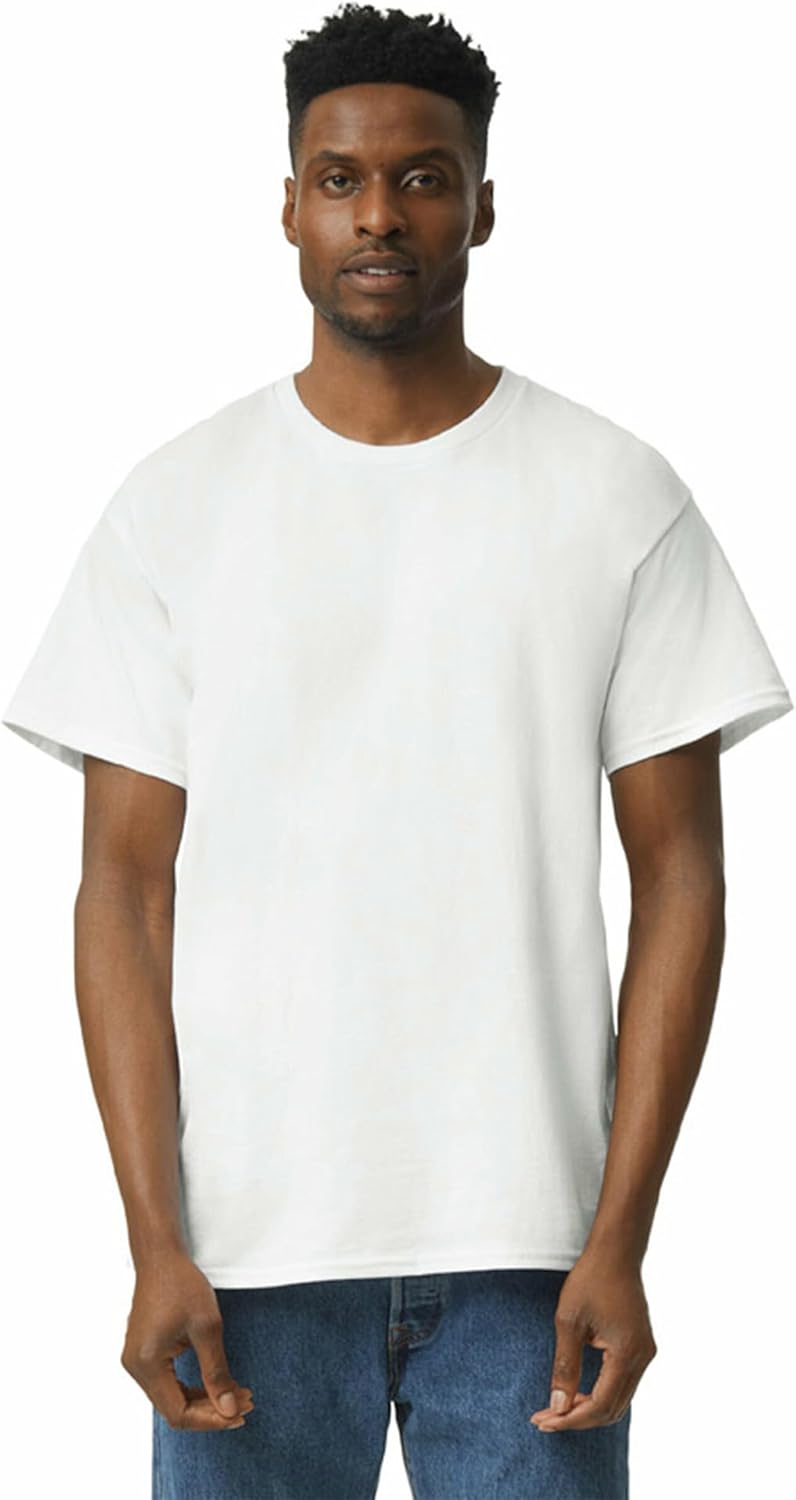
If you’ve ever stared at a wall of multipack t-shirts — three white tees for $12, or a five-pack for $22 — and wondered whether you’re buying something you’ll love wearing or something you’ll quietly retire after six washes, this article is for you. A multipack is exactly what it sounds like: a bundle of identical t-shirts sold together at a lower per-unit cost than buying them one at a time. The pitch is simple value. But “value” is doing a lot of work in that sentence, because a $4-per-shirt Hanes and a $7-per-shirt Pro Club heavyweight are not the same product solving the same problem. The difference lives in the fabric weight (measured in grams per square meter, or GSM — think of it as how substantial the fabric feels in your hand), the cotton construction, the cut, and ultimately how long the shirt holds up before it thins, yellows, or loses its shape. This guide maps each major tier so you can match the right multipack to your actual use case.
| EDITOR'S PICKPro Club Men's 6-Pack Heavyweig… | Mid-tierHanes Men's T-Shirt Pack - 4-Pa… | Budget pickHanes Men's Beefy-T T-Shirt | |
|---|---|---|---|
| Pack Count | 6 | 4 | 2 |
| Fabric Weight | Heavyweight | — | Heavyweight |
| Size Options | XX-Large | Large | Tall Medium |
| Big & Tall | — | Available | — |
| Price | $56.99 | $18.22 | |
| See on Amazon → | See on Amazon → | See on Amazon → |
The Three Tiers Worth Your Attention (and One You Can Skip)
The multipack market in 2026 has consolidated around a handful of genuine workhorses. Here’s how they stack against each other before we get into the math.
Hanes Ecosmart / ComfortSoft (~$10–$14 for a 5-pack) Hanes is the mass-market floor. The ComfortSoft and Ecosmart lines — the ones you find in grocery stores and big-box chains — run around 150–160 GSM. That’s light. For context, Put This On’s fabric-weight primer describes anything under 160 GSM as approaching “tissue-weight” for a knit tee, suitable for layering under flannel or for pure disposability but not as a standalone garment you expect to look good in. These shirts are cotton-polyester blends (the Ecosmart line is typically 50/50), which helps them resist shrinkage and survive machine drying better than a pure cotton alternative at the same weight. The trade-off: poly blends don’t breathe as well, tend to pill faster at points of friction, and develop that characteristic gray-ish cast after repeated washing. Per-shirt cost sits at roughly $2.00–$2.80. At that price, you are buying consumables, not wardrobe pieces.
Gildan Heavy Cotton / Ultra Cotton (~$18–$28 for a 5–6 pack) Gildan is where the value conversation actually gets interesting. The Heavy Cotton line is spec’d at 185 GSM; the Ultra Cotton runs slightly heavier at 203 GSM. Both are 100% ring-spun cotton — a construction where cotton fibers are twisted (spun) tightly before weaving, producing a smoother, stronger yarn than open-end spun alternatives. Wirecutter’s longstanding best-basics coverage has repeatedly flagged Gildan’s Ultra Cotton as the benchmark for understanding what “cheap but not flimsy” actually means at scale. GQ’s plain-tee roundups echo this: reviewers note that the Ultra Cotton holds its shape through wash cycles in a way that comparably priced Hanes offerings do not. Per-shirt cost: roughly $3.50–$4.50. That’s a meaningful step up from Hanes, and for most everyday applications — undershirts, gym tees, blanks for custom printing — it’s the right trade-off. The fit skews boxy-American-traditional, and the shoulder seams on larger sizes can run wide. Know that going in.
Pro Club Heavyweight (~$50–$65 for a 6-pack) Pro Club is the practitioner’s quiet favorite. The Heavyweight line runs 6.5 oz per square yard — approximately 220 GSM — and is 100% cotton in a tubular construction (meaning the shirt body is knit as a seamless tube, eliminating the side seam that can twist or pucker after washing). Highsnobiety’s coverage of workwear-adjacent basics has noted Pro Club as one of the few mass-multipack brands that routinely gets referenced alongside single-unit premium basics on aesthetic grounds — not because it’s fashion-forward, but because the structure and opacity are genuinely superior at the price. Per-shirt cost lands at approximately $8.50–$10.80 depending on where you source it. That’s two to three times the Gildan price, which demands justification — and the justification is durability and presence. Owners consistently report Pro Club heavyweights lasting three to five years of regular rotation without the fabric thinning at the collar or chest. The shirt doesn’t cling, doesn’t go translucent, and doesn’t lose structure.
By the Numbers: Cost Per Shirt vs. What You’re Actually Buying
| Brand / Line | Typical Pack Price | Per-Shirt Cost | Fabric Weight | Cotton Type |
|---|---|---|---|---|
| Hanes ComfortSoft 5-pack | ~$12 | ~$2.40 | ~155 GSM | 50/50 cotton-poly blend |
| Gildan Heavy Cotton 6-pack | ~$22 | ~$3.65 | ~185 GSM | 100% ring-spun cotton |
| Gildan Ultra Cotton 6-pack | ~$27 | ~$4.50 | ~203 GSM | 100% ring-spun cotton |
| Pro Club Heavyweight 6-pack | ~$58 | ~$9.65 | ~220 GSM | 100% cotton, tubular |
Prices reflect major U.S. retailer averages as of May 2026. Weights are per published manufacturer specs.
The gap between Hanes and Pro Club on a per-shirt basis looks enormous — $2.40 versus $9.65. But if the Hanes shirt lasts 18 months before it’s unusable and the Pro Club lasts 48 months, the cost-per-month math actually inverts. You’re paying roughly $0.13/month for a Hanes consumable versus $0.20/month for a Pro Club — closer than the sticker price suggests, and the Pro Club still wins on every qualitative measure.
Where Each Tier Actually Makes Sense
The mistake most people make is buying one tier for every use case. That’s leaving value on the table in both directions.
Use Hanes when: You need undershirts that live under dress shirts and never see the outside world. The lighter weight actually works in your favor here — less bulk under a tailored collar. The poly blend resists moisture-wicking worse than performance fabrics but absorbs less than heavy cotton, which matters when you’re wearing something over it. Buy a 10-pack, replace annually, treat them like socks.
Use Gildan Ultra Cotton when: You need blank tees for custom printing — screen printing, DTG (direct-to-garment digital printing), heat transfer — and you need consistent results across a large order. The Textile Exchange’s 2024 Preferred Fiber report notes that ring-spun cotton surfaces accept ink more evenly than open-end spun alternatives because the smoother yarn creates less surface variation. Gildan’s production consistency at scale is also unusually reliable: the dye lots, collar construction, and sizing hold tight across large runs, which matters if you’re a brand founder or stylist ordering 50+ units. Per-shirt cost at volume is hard to beat for the quality floor it delivers.
Use Gildan Heavy Cotton when: You want a casual weekend tee on a strict budget and you don’t need the shirt to be a statement piece. At 185 GSM, it won’t drape as crisply as the Ultra Cotton, but it’s thicker than anything in the Hanes range. The fit runs boxy enough that if you’re between a medium and large, you may want to size down — multiple aggregated reviews flag this consistently.
Use Pro Club Heavyweight when: The tee is the outfit. Not a layer, not a blank — the thing people are looking at. The tubular construction means the shirt sits cleanly without the side-seam roll that plagues washed Gildans over time. The weight means it photographs well, which matters if you’re a stylist sourcing samples. And the opacity means white is actually white, not translucent under fluorescent lighting. Pro Club’s 3XL and 4XL sizing is also a notable advantage — the proportions scale more faithfully in larger sizes than most comparable brands, per aggregated reviews from extended-size communities.
The Variable Nobody Talks About: Collar Longevity
Every practitioner conversation about multipack tees eventually arrives at the collar. It’s the canary. Once a collar stretches, the shirt is functionally over — you can restore shape through washing methods, but the collar rib has a finite elasticity memory, and cheap rib knit loses it fast.
Gildan’s collar uses a standard rib-knit construction reinforced with tape at the back neck seam. Owners report it holds shape reliably through 30–40 wash cycles at normal temperatures. Pro Club’s collar construction runs heavier rib, and long-term owners consistently report collars staying set well past the 60-wash mark. Hanes collarwork is the weakest link in the lineup — the lighter rib on ComfortSoft lines begins to flute (develop that wavy, stretched-out look) noticeably earlier, often within 15–20 washes at higher temperatures.
The fix is simple: wash cold, hang dry or use low heat. But if you know you’re a hot-wash person — or if you’re sourcing for a client who is — weight the collar longevity variable heavily. It will define perceived quality faster than fabric hand.
The Decision Frame
If you’re landing on a purchasing decision right now, here’s the clean version:
If cost-per-shirt is the primary constraint and the tee will be worn under other layers: Hanes ComfortSoft. Buy in bulk, replace without guilt.
If you’re ordering blanks for custom decoration at any volume above 10 units: Gildan Ultra Cotton. The ring-spun surface, size consistency, and per-unit economics are unmatched for this use case.
If you want a casual tee that survives two or three years of regular wear and you’re not willing to spend single-unit pricing: Gildan Ultra Cotton again, sizing down one if you want a cleaner silhouette rather than the traditional boxy fit.
If the tee is a visible, standalone piece — and you want it to actually look like you thought about it: Pro Club Heavyweight. The $9–$10 per shirt price is real money for a multipack, but it’s still a fraction of what you’d spend on a single Everlane or Buck Mason basic, and the structural quality clears that bar in most objective comparisons.
The multipack category gets dismissed as commodity territory, but that’s a misread. Understanding what you’re buying at each GSM and construction level is the same skill you use evaluating any other garment investment — it just starts at a lower price point. The brand names change; the framework doesn’t.